Homemade Energy Bars for Trail Running: 35 g Carbs Each
Oats, dates, honey, peanut butter and a pinch of salt: 10 bars at about 35 g of carbs each. With the maths, an hour-by-hour fueling plan and tips to keep them in the heat.
12.10.2026
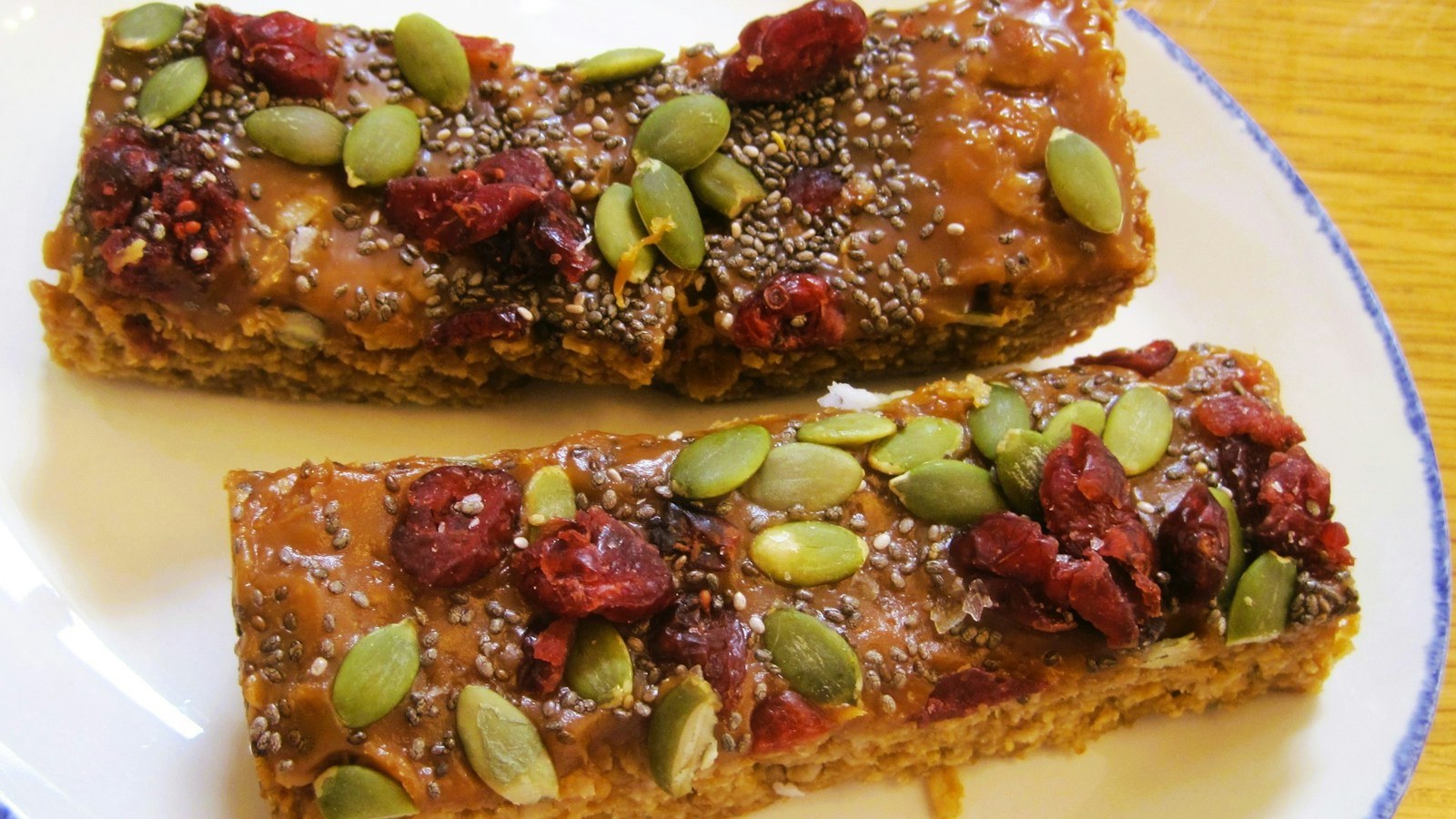
A homemade energy bar is a no-bake bar of rolled oats, dates, honey, peanut butter and a pinch of salt, pressed into a tray and cut into pieces. With the recipe below, each bar weighs about 54 g and delivers about 35 g of carbohydrate, so one bar an hour already meets the low end of the 30–60 g of carbs per hour that sports-nutrition bodies recommend for runs longer than an hour.
I make these for long weekend runs and for races where gels start to feel sickly by hour three. The real win is not the taste (although they taste great). It is that you know exactly how many carbs are in every bite, which makes an hour-by-hour fueling plan far easier.
Quick summary
- Recipe for 10 bars: 200 g rolled oats, 200 g pitted dates, 60 g honey, 80 g peanut butter, a pinch of salt.
- Each bar ≈ 54 g, ≈ 35 g carbs, ≈ 200 kcal, ≈ 4 g fiber (calculated from USDA data).
- On the run: 30–60 g carbs per hour for 1–2.5 hours; longer efforts can go up to 90 g per hour if your gut is trained.
- Keep them in the fridge, wrap each bar, and pre-cut them in halves on race day.
- Always test them on a long run first. Never debut a new food on race day.
How many carbs per hour do you need on the trail?
The 2016 joint position statement of the Academy of Nutrition and Dietetics, Dietitians of Canada and the American College of Sports Medicine (Thomas, Erdman & Burke) advises 30–60 g of carbohydrate per hour for endurance efforts lasting 1–2.5 hours. For efforts beyond 2.5 hours, trained athletes can absorb up to about 90 g per hour, provided the carbs come from a mix of glucose and fructose.
Good news: honey and dates both contain glucose and fructose, so this bar is more than "oats to fill you up". But 90 g an hour is an ultra runner's number, built over months of gut training. If you are heading for your first trail races (see what trail running is and how to start), aim for 30–45 g an hour first.
No-bake energy bar recipe (10 bars)
Ingredients
- 200 g rolled oats (old-fashioned; quick oats work but give a softer bar)
- 200 g pitted dates (easy to find in Vietnamese supermarkets and markets, especially around Tết)
- 60 g honey (about 3 tablespoons)
- 80 g unsweetened peanut butter (about 4 tablespoons)
- A pinch of salt (about 1 g, a level 1/4 teaspoon)
- Optional: 1–2 tablespoons of warm water if the mix is too dry
Method
- Toast the oats (optional): stir them in a dry pan over medium heat for 3–4 minutes. Not required, but it removes the "raw flour" taste.
- Blend the dates: if they are hard, soak them in warm water for 10 minutes, then drain. Blend or chop into a sticky paste.
- Make the binder: gently warm the honey and peanut butter (20 seconds in the microwave or a small pan on low heat) so they mix easily, then add the salt.
- Mix: combine oats, dates and binder in a large bowl. Knead with (gloved) hands until the mix holds together when squeezed. Too dry? Add warm water a spoon at a time.
- Press: line a tray of about 20 × 20 cm with baking paper and press the mix hard and flat, 1.5–2 cm thick. The harder you press, the less the bars crumble in your vest.
- Chill: 1–2 hours in the fridge to firm up, then cut into 10 equal bars. For precision, weigh the batch and divide by 10.
How many carbs per bar?
Calculated from USDA FoodData Central (values per 100 g of the raw ingredient; carbohydrate "by difference" includes fiber):
| Ingredient | Amount | Carbs / 100 g | Carbs in batch |
|---|---|---|---|
| Rolled oats | 200 g | 67.7 g | 135.4 g |
| Dates | 200 g | 75.0 g | 150.0 g |
| Honey | 60 g | 82.4 g | 49.4 g |
| Peanut butter, unsalted | 80 g | 22.3 g | 17.8 g |
| Salt | 1 g | 0 | 0 |
| Whole batch (≈ 541 g) | 352.6 g | ||
| Per bar (1/10) | ≈ 54 g | ≈ 35 g |
The same calculation gives about 200 kcal and nearly 4 g of fiber per bar. Note that USDA lists oats at about 68 g of carbs per 100 g, higher than the "60 g" figure that often gets passed around. If your brands differ, take the numbers from the labels and redo the sum: total batch carbs divided by the number of bars.
Planning your fueling hour by hour
| Target | How to hit it with a 35 g bar |
|---|---|
| 30 g/hour | Half a bar every 30 minutes (≈ 17 g each) |
| 45 g/hour | 1 bar/hour + electrolyte drink or half a gel (check the label) |
| 60 g/hour | 1 bar/hour + 1 gel, or alternate bars and gels |
I prefer half a bar every 30 minutes to a whole bar at once: easier to chew while breathing hard, steadier blood sugar, and a lighter stomach. Set a 30-minute alert on your GPS watch, because tired brains forget to eat.
Variations for taste and for the race
- Cashew butter instead of peanut butter: Vietnamese cashews are easy to find and the taste works well. Carbs shift slightly, so check the label.
- Add raisins (about 80 g carbs per 100 g, per USDA) for a more carb-dense bar for long races.
- Less peanut butter for hot races: less fat is easier to digest above 30°C, but the bar crumbles more, so add a little extra honey.
- Skip chocolate in the south: it melts in a vest pocket within minutes.
- Chia seeds: very high in fiber (over 30 g per 100 g, per USDA). Use a sprinkle only; you want an energy bar, not a fiber bar.
Storing bars in Vietnam's heat and humidity
These bars contain no egg, milk or butter, but they are still fresh food without preservatives.
- Fridge, in an airtight box, and eat them within about a week to stay safe and tasty.
- Freezer for big batches: wrap each bar and take one out before your run. A frozen bar is chewable after a few minutes in hot weather.
- Wrap each bar in baking paper, then put them in a zip bag. Baking paper does not cling like plastic wrap and opens with one hand.
- Race day: pre-cut halves at home. At 30–35°C the honey and peanut butter soften and the bars get sticky, so carry them in a chest pocket, not against your back.
- A bar that spent a whole run in the sun does not go back in the fridge for tomorrow.
Test before you race: the most important rule
Solid food like this has fiber and fat, so it digests more slowly than a gel. For many runners that is a plus (lasting energy, less flavor fatigue); for others it means a stomach ache at km 25. The only way to know is to test:
- Try them on a long run of 2 hours or more, with climbing, at the same time of day as the race.
- Eat while power-hiking uphill: lower heart rate, easier chewing. When running fast or on technical descents, switch to gels or electrolyte drinks.
- Take a few sips of water after each bite. A dry bar with no water is the fastest route to choking on it.
- Train your gut by raising your carbs per hour gradually over several weeks, as sports dietitians advise.
- Check the race rules: some long trail races list emergency food in the mandatory kit. Check each race in the 42–80 km races and the races over 80 km.
Common mistakes
- Bars that are too big: 80–100 g sounds like value but is hard to eat on the move. 50–55 g is right.
- Carbs only, forgetting salt and water: the pinch of salt in the recipe is mostly for taste; it does not replace electrolytes when you sweat all day.
- Changing the recipe the week before the race: stick with the version you tested.
- Carrying only homemade bars for an ultra: after many hours you will want a different texture and taste. Carry gels too, and use the aid stations.
Frequently asked questions
How long do homemade energy bars keep?
About a week in the fridge in a closed box, longer in the freezer. Out in the heat, eat them the same day.
Can oat bars replace gels?
Partly, especially at easy pace and on climbs. When running fast or late in a race, gels and carb drinks are easier to absorb. Most long-distance trail runners combine both.
Do I need to eat during a 21 km race?
If you finish in under about an hour, usually not. But a hilly 21 km trail can take a recreational runner 3–4 hours, and then 30–60 g of carbs per hour makes sense. Browse the 21–42 km races to estimate your time.
Read more
- What is trail running? A beginner's guide
- Gear and nutrition shops for trail runners
- Upcoming registration deadlines
Sources: USDA FoodData Central (IDs 173904 oats, 168191 Medjool dates, 169640 honey, 172470 unsalted peanut butter, 168165 raisins, 170554 chia seeds); Thomas, Erdman & Burke (2016), Nutrition and Athletic Performance, J Acad Nutr Diet; Beelen, Cermak & van Loon (2015), Maastricht University. Updated October 2026.
Keep reading
Homemade Sports Drink for Trail: Malto, Sugar, Lime, Salt
A homemade trail sports drink for 500 ml and 750 ml bottles: maltodextrin, sugar, lime and salt, building from 30 to 60 g of carbs per hour over 6 weeks.
Read →
Trail Running Gear by Distance: 21K to 100-Mile Checklist
From 1 litre of water at 21K to two headlamps at 100 miles: a mandatory gear table by distance based on VMM 2026, compared with UTMB standards, plus what's worth adding.
Read →
How to Get Cheaper Trail Race Entries in Vietnam
Trail race prices rise in tiers. How to pay less: register early bird, join groups like Trail Station or AR Saigon, track deadlines and read the refund rules.
Read →