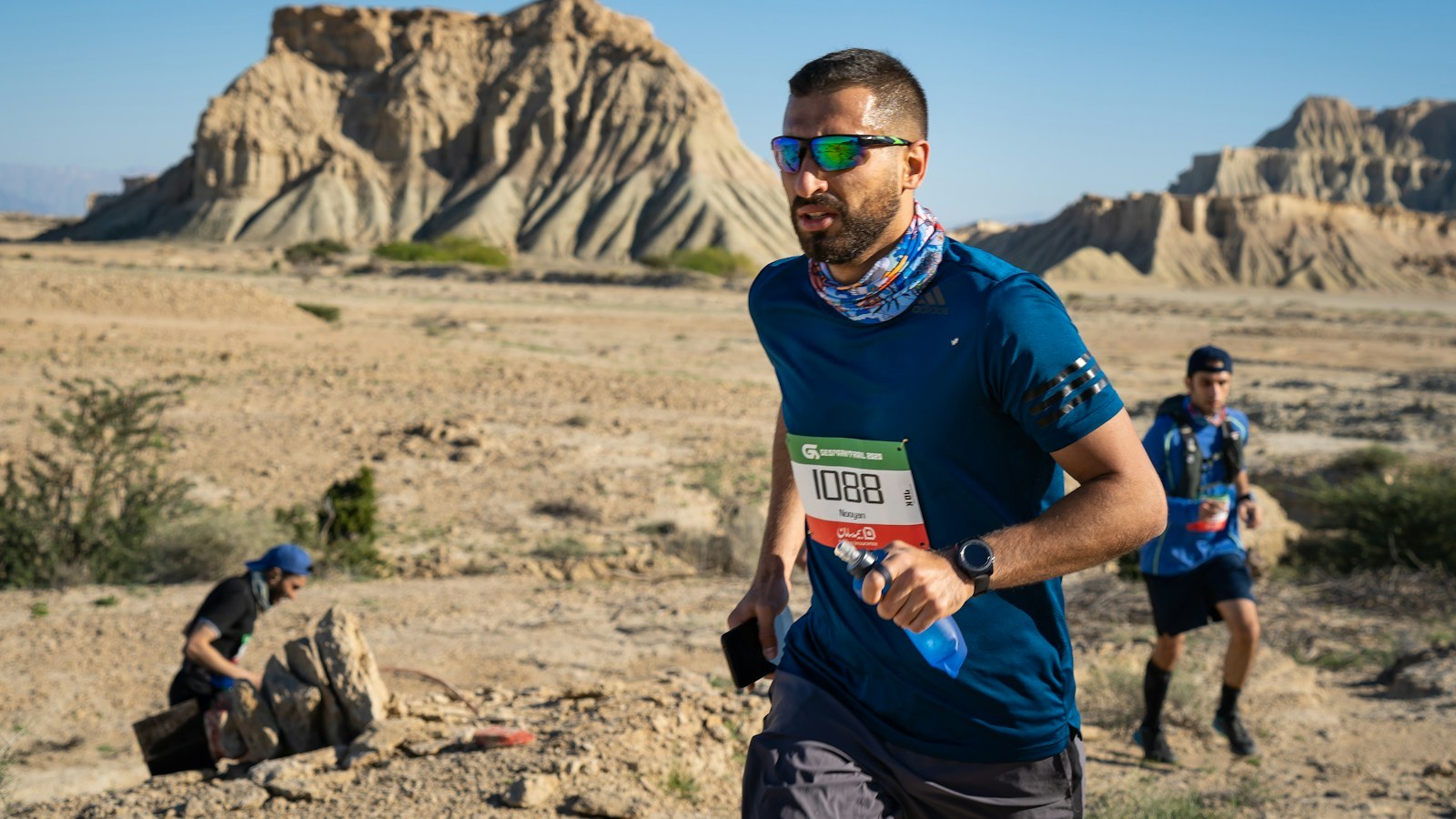
Trail running in prescription glasses comes with two problems: fogged lenses on climbs and at aid stations, and glare that regular glasses do nothing about. For fog, the cheapest fix is a thin layer of dish soap on both sides of the lens, left to dry and lightly buffed. For sun, you have three main options: prescription sunglasses, a clip-on sun lens over your glasses, or a prescription insert behind sport sunglasses (only a few brands make them).
I have run with all three, and none is perfect. This guide helps you pick the one that fits your prescription, your budget and the races you run.
Quick summary
- Anti-fog: one drop of dish soap, spread on both sides, let it dry, buff lightly with a microfiber cloth. It wears off, so carry some to reapply.
- Prescription sunglasses: the simplest and widest view, but usually the most expensive, and wraparound frames limit which prescriptions work.
- Clip-on sun lens: cheap and light, but it can bounce on descents and leaves the sides open.
- Prescription insert behind sport sunglasses: wraparound protection and swappable lenses, but two layers fog more, and only some brands such as Julbo and Rudy Project make them.
- Contact lenses: another option; talk to an eye doctor first.
Why do glasses fog up on the trail?
Warm, humid air from your face, breath and sweat hits a cooler lens and condenses into countless tiny droplets. Each droplet bends light, so you see as if through mist. In Vietnam, the usual scenarios are:
- Slow climbs: low speed, no airflow over the lenses, and you are at your hottest.
- Aid station stops: the moment you stop, the lenses go white.
- Humid forest at dawn and mountain mist on northern courses (see trail races in northern Vietnam).
- Sweat dripping from your forehead onto the lenses.
The dish soap anti-fog trick
It sounds like a kitchen hack, but it has real science behind it. As Joe Schwarcz of McGill University's Office for Science and Society explains, soap lowers the surface tension of water: instead of beading into droplets, the moisture spreads into a thin, clear film that does not block your view. Commercial anti-fog sprays work on the same principle. In 2011, Malik and Malik described in the Annals of the Royal College of Surgeons of England how washing glasses in soapy water and letting them dry kept them clear under a surgical mask.
How to do it
- Start with clean, dry lenses. Rinse off dust and grit first; rubbing grit scratches.
- One drop of plain dish soap, without hand-care lotion (lotion soaps leave streaks).
- Spread it on both sides of each lens with a clean fingertip, as a very thin layer.
- Let it dry for about a minute.
- Buff lightly with a microfiber cloth until the streaks are gone. Go easy: the goal is an invisible film left behind, not wiping it all off.
Good to know
- It is temporary. Sweat and rain wash the film away. Put a little dish soap in a tiny bottle (a rinsed eye-drop bottle works) to reapply during long races.
- Ask your optician if your lenses have special coatings (anti-reflective, factory anti-fog): not every coating tolerates household soap.
- Do not wipe with your running shirt. Sweaty fabric carries salt and dust that scratch and smear. Keep a microfiber cloth in a zip bag in your vest.
- Cut the moisture at the source: a headband or cap stops forehead sweat; on climbs, slide your glasses a little lower on your nose to let air through.
Sunglasses when you wear prescription glasses: 3 options
1. Prescription sunglasses
An optician cuts lenses to your prescription and tints them, polarizes them or makes them photochromic, then fits them into a sport frame or a regular one.
- Pros: one pair, light, the widest view because there is no second layer, few places for fog to hide. Photochromic lenses handle dark forest to sunny summit.
- Cons: usually the most expensive option, especially in a sport frame. The more a frame wraps, the harder the prescription: according to Rx-Safety, a total power per eye outside roughly -4.00 to +3.00 already risks poor adaptation to wraparound lenses. A new prescription means new lenses. Without photochromic lenses, you still need clear glasses for night sections.
- In Vietnam: take the frame you want and your prescription to an optician, ask whether they can cut tinted prescription lenses for that frame, and whether to go polarized or photochromic.
2. Clip-on sun lens over your glasses
A tinted front that clips or snaps magnetically onto the glasses you already wear, usually with a flip-up hinge.
- Pros: the cheapest, light, and you keep the glasses you are used to. Flip it up in dark forest or stash it in your vest.
- Cons: it can rattle and shift on technical descents. A flat clip-on leaves the sides open to sun and wind. It has to match your frame shape. And the extra layer can trap moisture between the two lenses.
3. Prescription insert behind sport sunglasses
A small frame holding prescription lenses that sits behind the sun lens of sport sunglasses, close to your eyes. Only a few brands make them, and each insert fits only certain frames:
- Julbo sells optical clips (Opticlip) for some of its sunglasses and goggles. According to Julbo's US site, prescription lenses are not included and must be fitted by your eye care provider.
- Rudy Project sells the RX Optical Insert, which clicks in behind the sun lens; each version fits a few models (for example Kelion, Spinshield Air, Astral). An optician makes the prescription lenses.
Pros and cons of this route:
- Pros: wraparound frame with good sun and wind protection. Swap sun lenses, or clear ones for night, while keeping your prescription. Break a sun lens and the insert survives.
- Cons: two layers of lenses fog more. The small prescription lens narrows the edges of your view. Slightly heavier. Hard to find in Vietnam: usually ordered through a distributor or from abroad, then glazed by a local optician. Rudy Project pitches its basic insert at people needing only mild correction.
What about contact lenses?
Contact lenses (daily disposables especially) give a wide view, no fog, and you can wear ordinary sunglasses on top. On the other hand, dust, wind and sweat can irritate your eyes in long races, and handling lenses in the forest needs clean hands. If you want to try them, ask an eye doctor, practise on several long runs, and always carry your glasses as a backup.
Quick comparison
| Option | Price | Weight | Field of view | Fog | Convenience |
|---|---|---|---|---|---|
| Glasses + dish soap trick | ₫ | Light | As usual | Reduced, reapply | No sun protection |
| Prescription sunglasses | ₫₫₫ | Lightest | Widest | Low (one layer) | One pair; clear pair needed at night (unless photochromic) |
| Clip-on sun lens | ₫ | Light | Narrow at the sides | Can fog between layers | Flips up, can bounce |
| Insert behind sport sunglasses | ₫₫ – ₫₫₫ | A bit heavier | Narrower edges | Highest (two layers) | Day/night lens swaps, hard to buy |
| Contact lenses | ₫₫ (ongoing) | Negligible | Wide | None | Dust, wind, hygiene |
Price levels are relative only and depend on frame, lenses and shop; ask your optician for a real quote.
Which one should you choose?
- New to trail, short forest races: your usual glasses + the dish soap trick + a cap are enough. See what you need to start trail running.
- Long races with exposed, sunny ridges: prescription sunglasses, ideally photochromic.
- Ultras with night running: an insert in sport sunglasses with swappable lenses, or photochromic glasses plus a clear backup. Browse the races over 80 km.
- Tight budget: a clip-on, chosen to fit snugly, and tested on a descent before you trust it.
What to carry in your vest
- A microfiber cloth in a zip bag, and a tiny bottle of dish soap.
- A glasses strap for technical descents.
- A hard case if you wear contacts or carry spare glasses.
Read more
Sources: Joe Schwarcz, McGill Office for Science and Society; Malik & Malik (2011), Annals of the Royal College of Surgeons of England; Julbo, optical clips; Rudy Project Optical Insert (Rose Bikes); Rx-Safety, prescription limits and lens curvature. Updated October 2026.
Keep reading

Homemade Sports Drink for Trail: Malto, Sugar, Lime, Salt
A homemade trail sports drink for 500 ml and 750 ml bottles: maltodextrin, sugar, lime and salt, building from 30 to 60 g of carbs per hour over 6 weeks.
Read →
Trail Running Gear by Distance: 21K to 100-Mile Checklist
From 1 litre of water at 21K to two headlamps at 100 miles: a mandatory gear table by distance based on VMM 2026, compared with UTMB standards, plus what's worth adding.
Read →
Homemade Energy Bars for Trail Running: 35 g Carbs Each
Oats, dates, honey, peanut butter and a pinch of salt: 10 bars at about 35 g of carbs each. With the maths, an hour-by-hour fueling plan and tips to keep them in the heat.
Read →